
When organizations want to understand a population, surveys are often the first tool they reach for. Surveys are valuable. They quantify sentiment, measure satisfaction, and help validate known assumptions.
But surveys have limitations.
They can only measure the questions that are asked.
What happens when we let people decide for themselves what to raise, in their own words, at whatever length they choose?
That question sits at the heart of digital ethnography, the discipline that combines anthropology, qualitative research, and expert human interpretation to uncover patterns within publicly shared experiences and conversations. At Feedback, we use digital ethnography to transform behavioral evidence into actionable intelligence that helps organizations identify emerging issues, uncover root causes, understand real-world impacts, and prioritize action where it can create the greatest impact.
A Different Kind of Research
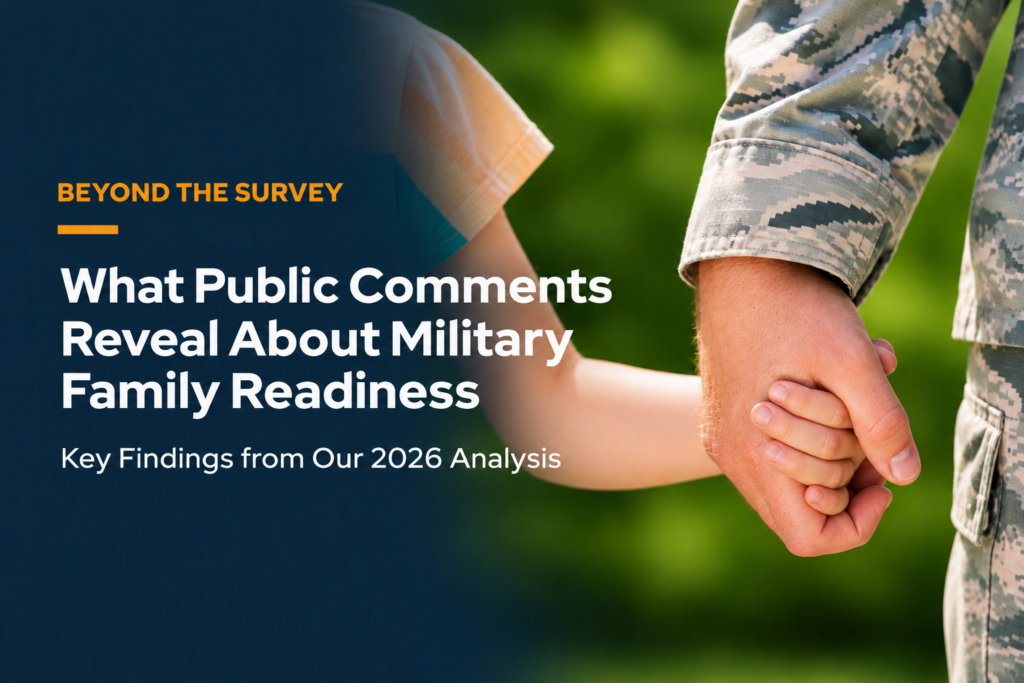
In 2026, the Department of War invited public comment through a Federal Register Request for Information (RFI) on 2028 state priorities affecting service members and their families. The comment period provided a unique opportunity to examine concerns, experiences, and recommendations raised by military families, veterans, service members, advocacy groups, and other stakeholders.
Unlike a survey, the RFI did not provide predefined answer choices. Participants determined what mattered most. They decided what challenges to raise, what experiences to share, and what solutions to recommend.
This distinction matters.
Surveys tell us what people think about known issues.
Open-ended analysis reveals what people believe is important enough to raise when no one has ranked the options for them.
The resulting analysis can provide a richer understanding of human behavior, system interactions, and policy outcomes than traditional methodologies alone.
What We Learned
Our analysis revealed a consistent pattern across employment, healthcare, education, housing, childcare, veteran services, and mental health.
The comments point less to a need for more programs and more to a need for systems that work together.
Again and again, commenters described how military mobility magnifies fragmentation between federal, state, and local systems. Policies intended to support military families often encounter implementation challenges as families move across jurisdictions, creating unintended barriers to continuity of care, employment, education, and support services.
Several themes emerged consistently:
- Military spouse employment and career portability
- Cost-of-living pressures and housing challenges
- Access to dependent medical records
- Military-connected education
- Childcare and family support
- Veteran transition services
- Mental health accessibility
- Continuity of care
While these issues are not new, the comments provided something rarely captured through surveys alone: context.
Why This Matters Now
Until recently, this was a description of a problem. As of December 2025, it is also a reporting requirement. Section 662 of the FY2026 National Defense Authorization Act amended 10 U.S.C. § 1056 to require that relocation assistance include destination information on education systems, school enrollment procedures, and state-specific provisions under the Interstate Compact on Educational Opportunity for Military Children; PCS services covering school transition, academic continuity, and special education; and educational planning for dependent children with disabilities, including transfer of individualized education programs and coordination with the Exceptional Family Member Program. Families must receive it no later than 45 days before the move.
Almost all of that is administered by states. The military departments are now obligated to brief families accurately on systems they do not run and to report to Congress annually for three years on how implementation is going.
This is precisely where delivery data runs out. A department can count briefings held and materials distributed. It cannot tell Congress whether a family’s IEP transferred, whether a spouse’s license cleared, or whether an EFMP handoff occurred. That evidence exists in what families say about their own experiences, the kind of context an open-ended public comment record can help surface.
Why Digital Ethnography Matters
Today’s leaders operate in increasingly complex environments.
Understanding human behavior requires more than data points and percentages. It requires context.
Digital ethnography uncovers the stories behind the statistics, the barriers behind the behaviors, and the solutions being proposed by those closest to the challenge. By examining open-ended, self-authored accounts and publicly shared experiences, organizations gain insight into emerging issues, unintended consequences, and opportunities for intervention before they become larger strategic risks.
For military family advocacy, the implications are significant.
Public commentary revealed that many challenges are not rooted in a lack of resources but in fragmentation between systems responsible for delivering those resources. Understanding where those breakdowns occur provides leaders with a clearer path toward meaningful change.
Looking Forward
As participation in public forums continues to grow, organizations have an unprecedented opportunity to listen, learn, and act. The voices of stakeholders contain not only expressions of concern but valuable insight into root causes, emerging issues, and practical solutions.
The future of research is not choosing between quantitative and qualitative methods.
It is combining them.
When traditional research is paired with digital ethnography, leaders gain a more complete picture of how people think, what they experience, and where action can create the greatest impact. That is how organizations move beyond measuring sentiment and toward driving meaningful change.
Interested in a briefing on the findings? Contact Us